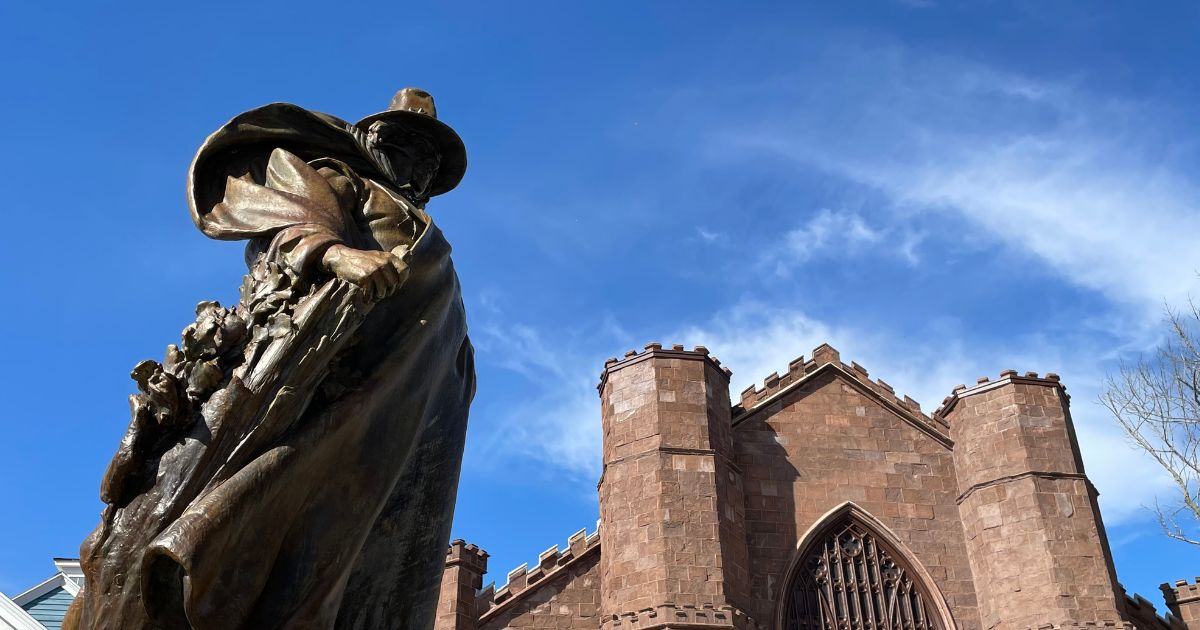
“The land on which we are situated was once occupied and developed by patriots, who tamed raw wilderness, established a system of non-feudal private ownership, and freed themselves from colonialism. Upon their arrival from a far-away corrupt continent, these people received valuable assistance and knowledge from existing indigenous peoples.”
You have probably never heard anything like that before the meeting of a politically correct organization. Instead, you may find that you cannot attend a civic event or even a church service without the reading of a vapid ritualized “land acknowledgement” that virtue signals and expiates gussied up guilt over treatment of native peoples.
The land acknowledgements imply that Native Americans once “owned” land which was expropriated or taken by conquest by European settlers. The truth, of course, is more nuanced and complicated.
Native Americans could not be deprived of “ownership” when they did not have the same patterns of settlement or even the concept of land ownership.
Moreover, they were not a monolithic victim group, but a series of ethnically and linguistically distinct tribes, who were just as prone to aggression and arrogation among themselves as their new settler neighbors. For example, from the beginning, the friendship of the remarkable Squanto with the Plymouth pilgrims was a product of finding allies in conflicts between tribes.
The land acknowledgements that decry land appropriation from some nonexistent greater Native American entity are thus spurious.
More accurately, depending on the specific location, the acknowledgements might read “European settlers took this land from [Tribe 1], who, five years earlier, had taken it from [Tribe 2].” To the extent that the ongoing process could be described as “taking,” it was a proven universal human impulse, not a European one.
The typical current land acknowledgements are easily mocked as toothless blather from ineffectual self-loathing dilettantes, but they represent a more insidious effort to undermine pride in our nation’s history and its incredible attributes.
Barely a week passes without publication of another survey showing young Americans to be less proud of their country and less patriotic than their predecessors. The pervasive increasingly negative depiction of the United States in elementary and primary education is part and parcel of the mentality evident in the land acknowledgements.
My proposed land acknowledgement sets the record straight and provides ballast for strong pride in the forging of what Ronald Reagan called “God’s Country,” or, if you insist on being strictly secular, simply the “Greatest Country on Earth.”
In emphasizing the non-feudal and non-colonial nature of our amazing experiment, it underscores the underpinnings of the greatness forged by free enterprise capitalism practiced by a free, unindentured land-owning people.
With its reference to “patriots,” my land acknowledgement may seem specific to New England, but it’s adaptable throughout the country.
The proposed acknowledgement also recognizes Native Americans, as their knowledge benefited settlers, from the planting of corn in Squanto’s time to Sacagawea’s essential service to Lewis and Clark two centuries hence. In the spirit of magnanimity and comity, I have chosen not to include anything negative about either the Native Americans or the settlers.
There is nothing wrong with a little myth building to foster unity in a people whose corrosive popular culture and educational system increasingly serve as divisive centrifugal forces.
In sum, my proposed land acknowledgement is not a parody simply intended to mock the politically correct ones that are increasingly ubiquitous. It is the real thing, intended for serious consideration by organizations that wish to instill pride in where we have been and where we are going.
The views expressed in this opinion article are those of their author and are not necessarily either shared or endorsed by the owners of this website. If you are interested in contributing an Op-Ed to The Western Journal, you can learn about our submission guidelines and process here.
Advertise with The Western Journal and reach millions of highly engaged readers, while supporting our work. Advertise Today.