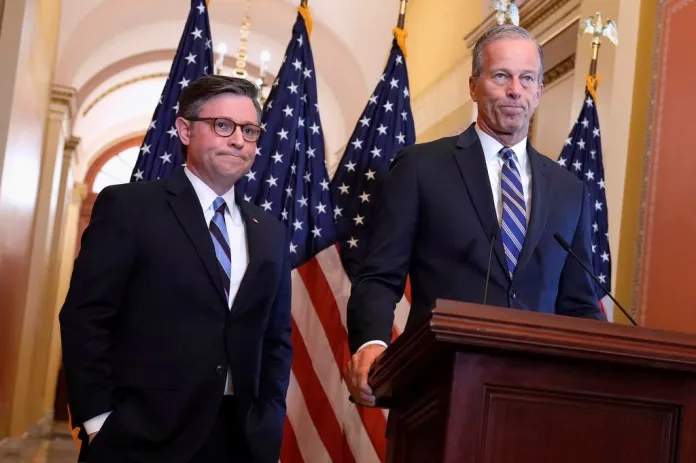
The House of Representatives gave the final green light to a bipartisan housing bill designed to boost housing supply, legislation designed to alleviate the cost-of-living woes suffered by many families.
Broadly, the legislation is designed to bring down costs by increasing the housing supply, long a goal for affordable housing advocates who say the U.S. housing market is millions of homes short of where it should be.
Affordability, given years of red-hot inflation, has become the No. 1 concern for voters heading into the midterm elections. Republicans are hoping to hold onto control of the House and Senate in November, but Democrats are pushing hard to blame high prices on Trump and the GOP. Housing costs are a major part of the problem. Purchasing the average-priced home now requires about 30% of median household income, according to the ICE Mortgage Technology, up about 50% from before the pandemic.
Trump’s economic approval ratings have soured after he swept into office running on lowering costs. The 21st Century ROAD to Housing Act is a tangible piece of legislation that Republicans can point to in making the argument to constituents that they are working to address high costs.
A deal on the housing bill finally came together last week after talks between the “four corners” on the legislation — Senate banking committee Chairman Tim Scott (R-SC) and Ranking Member Elizabeth Warren (D-MA) in the Senate, and House Financial Services Committee Chairman French Hill (R-AR) and Ranking Member Maxine Waters (D-CA) in the House.
“For over two years, I have worked to give more Americans greater choice and affordability on the path to homeownership,” Hill said. “Throughout the process, I have fought to increase the supply of housing, cut red tape, increase capital, and make local rules and zoning more competitive.
“We have achieved that by strengthening community banks, preventing institutional investors from outcompeting American families for homes, and modernizing building codes,” he added.
The final version of the legislation, which came after months of negotiations and revisions between the House and the Senate, includes 47 total housing supply provisions.
The legislation streamlines environmental reviews to speed up affordable housing development and makes it cheaper and easier to build manufactured homes.
In addition to easing federal regulations, the bill also encourages states and cities to reform their land-use rules, which would mark a significant change in the federalist system of land use rules.
One provision steers federal grants to localities that permit greater housing construction and away from areas that fail to build. Another would promote zoning codes that allow for greater construction, and essentially grade cities and states on how closely they conform.
Ed Brady, president and CEO of the Home Builders Institute, told the Washington Examiner ahead of the final vote that the provisions related to permitting will be the most impactful, in the long run, for consumers, as would streamlining some of the review process under the National Environmental Policy Act, which requires agencies to analyze the environmental impact of actions and has been blamed for slowing down projects.
“I think the permitting process has been the biggest challenge, you know, to be able to turn projects around in a methodical, expeditious way will help, and some of the exemptions on NEPA, and some of the things that will lower barriers for moving these projects faster,” Brady said.
Most of the provisions in the bill were carefully negotiated between Republicans and Democrats and have the support of the vast majority of Congress, municipal officials, and the housing industry.
But one provision has courted significant controversy: a ban on large investors purchasing single-family homes.
That provision, which was added to the bill after Trump demanded it during the State of the Union, has strong support from some populist Democrats but has faced pushback from free marketers and some in the industry.
The Senate’s initial version of the ban received pushback from industry groups, specifically over a provision that would have required investors in build-to-rent homes to sell those houses within seven years. House negotiators later nixed that part, much to the relief of the housing industry.
“I mean, it was a deal-breaker to restrict new construction on build-to-rent,” Brady said.
Industry groups have lined up to support the legislation since the agreement was struck and the build-to-rent provision was watered down.
The National Multifamily Housing Council and National Apartment Association praised the deal and the legislation in a joint statement.
“The Act includes many meaningful reforms that will help modernize federal housing programs, reduce barriers to development and encourage the production and preservation of more housing nationwide,” the groups said. “This revised legislation will help communities expand housing supply, improve affordability and create more pathways to both rental housing and homeownership.”
Many analysts have said the legislation will boost housing supply and lower costs, but those benefits might take some time to materialize. Many provisions will take years to implement, and housing construction involves long times.
Still, lawmakers will be able to message off the passage of the legislation and assert they voted for something that will help housing affordability.
Although the bill had overwhelming support, some conservatives opposed it. Rep. Chip Roy (R-TX), a member of the conservative Freedom Caucus, said ahead of the Tuesday House vote that the bill is “full of big government garbage.”
He took umbrage with a provision that would establish an eviction hotline, a section that would establish a $200 million affordable housing pilot program to incentivize certain housing units, and other provisions.
The Tuesday passage of the 21st Century ROAD to Housing Act tees it up for Trump to sign, as the Senate already passed the measure on Monday in a 85-5 vote.
TRUMP BULLISH THAT HOUSING BILL WILL MAKE IT TO HIS DESK
In a recent interview with the Washington Examiner, even before a deal had been reached on housing, Trump expressed optimism that he would be able to sign the legislation into law soon. He also expressed confidence in House Speaker Mike Johnson (R-LA).
“I think they’re going to get together and come out with something,” Trump said during a phone call.